Pedagogical Frameworks & Learning Models
Living Oracles Global Institute (LOGI) utilizes structured behavioral dimensions and modern cognitive frameworks to craft curriculum tracks. Explore the progressive stages of information processing, actionable target verbs, and structural mastery assessments below.
Recall, tell, show, match, list, label, define, cite, name, brainstorm
Objective tests, specialized worksheets, quick check quizzes, diagram labeling, reference tables
Compare, contrast, demonstrate, identify, report, outline, summarize, review, explain, catalog
Structured outlines, executive summaries, peer reviews, verification tests, identity exercises, comparative diagrams
Develop, organize, use, select, model, choose, construct, translate, experiment, illustrate
Analytical reports, interactive workflow diagrams, field projects, video case presentations, case studies, field journals
Analyze, categorize, classify, distinguish, dissect, examine, differentiate, calculate, solve, arrange
Mathematical modeling, research breakdowns, team debates, solution blueprints, interactive case-study evaluations
Combine, compose, solve, formulate, adapt, develop, create, validate, design
Academic articles, research essays, original tracking experiments, multimedia compositions, systemic designs, blueprint graphics
Assess, evaluate, determine, measure, select, defend, score, rank, discriminate, judge, justify, conclude, recommend
Structured peer reviews, critical self-evaluations, scoring matrices, research critiques, formal recommendation position pieces
Dr. L. Dee Fink's framework bypasses purely linear scaling to offer an interconnected circular web. It emphasizes relational, emotional, and spiritual transformation alongside conceptual intelligence.
Understand, remember, use, execute, conceptualize, critique, problem-solve
Enables students to understand foundational systems while gaining the immediate capacity to manage complex practical assignments.
Connect, synthesize, interrelate, self-reflect, empathize, lead, collaborate
Propels the learner to merge academic principles with real life, building robust ethical values, community leadership skills, and mutual understanding.
Value, internalize, care, inquire, self-direct, research, strategize
Changes the educational experience from passive requirements into an ongoing passion, ensuring students know how to locate, track, and process data long after graduation.
Norman Webb's model shifts focus entirely away from the specific action verb used, measuring instead the exact cognitive demand and context needed to completely resolve an active project requirement.
Requires simple recall of information, performing an established structural formula, or executing basic rote behaviors.
Stating biblical passages, tracking dates, identifying programmatic syntax, completing vocabulary definitions.
Requires processing or identifying patterns, organizing data elements, comparing concepts, or executing compound tasks.
Summarizing long narratives, classifying historical context data, solving complex multi-step financial logic equations.
Demands logical justification, defending multi-layered approaches, and resolving tasks that feature multiple valid solutions.
Critiquing theological perspectives, designing systems, defending research perspectives against alternative arguments.
Demands complex conceptual synthesis, executing independent research, and merging distinct multidisciplinary methodologies.
Authoring extensive institutional research monographs, creating complete software ecosystems, launch-testing curriculum programs.
Visual models illustrating structural hierarchies, interactive parameters, and systemic mappings across all analyzed curricular taxonomies.
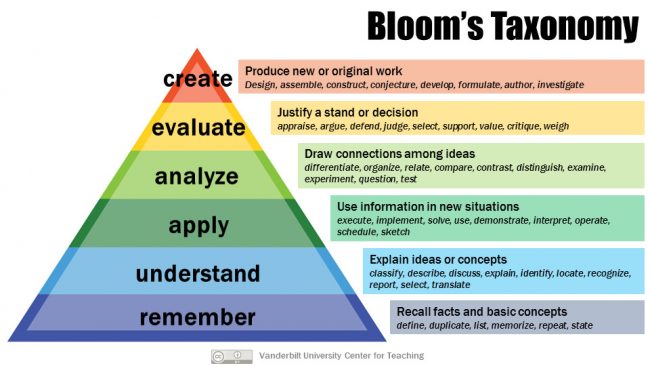 Figure 1.1: Bloom's Taxonomy Pyramid — A hierarchical progression scaling from foundational knowledge recall up to complex synthesis and creative generation.
 Figure 1.3: Webb's DoK Matrix — A structural breakdown focusing on the specific mental rigor and complexity levels required to resolve cross-disciplinary educational assignments.