
Workplace conflict is an inevitable component of organizational dynamics. Far from being an inherent marker of institutional failure, modern organizational research demonstrates that conflict—when constructively managed—can serve as a primary catalyst for innovation, critical problem-solving, and interpersonal cohesion (Rahim, 2011; De Dreu and Weingart, 2003). However, unmanaged interpersonal friction frequently escalates into toxic work environments, resulting in diminished organizational commitment and substantial financial productivity losses (Gottman and DeClaire, 2001; Lencioni, 2002).
For faith-centered leaders and contemporary executive teams alike, the challenge lies in transforming destructive disagreement into constructive dialogue. By synthesizing modern conflict management models with enduring Judeo-Christian ethical principles, organizations can construct robust systems for addressing grievances, building trust, and fostering long-term stability (Patterson et al., 2012; Sande, 2004).
"If it is possible, as far as it depends on you, live at peace with everyone." — Romans 12:18 (NIV)
1. Theoretical Foundations: Understanding Conflict Modes
Organizational scholars Thomas and Kilmann (1974) conceptualize individual responses to conflict across two primary dimensions: assertiveness (the extent to which an individual attempts to satisfy their own concerns) and cooperativeness (the extent to which an individual attempts to satisfy the concerns of others). These dimensions yield five distinct modes of conflict handling:
- Competing: High assertiveness, low cooperativeness. Effective during emergencies, but risks damaging workplace relationships if overused.
- Avoiding: Low assertiveness, low cooperativeness. Postpones resolution, allowing underlying issues to fester (Lencioni, 2002).
- Accommodating: Low assertiveness, high cooperativeness. Preserves harmony at the expense of substantive personal or strategic concerns.
- Compromising: Moderate assertiveness and cooperativeness. Seeks expedient, mutually acceptable middle-ground solutions.
- Collaborating: High assertiveness and high cooperativeness. Investigates deep-seated issues to arrive at win-win outcomes (Thomas and Kilmann, 1974).
2. A Biblical Foundation for Conflict Resolution
Complementing secular conflict theory, biblical literature offers an ethical foundation centered on restoration, mutual respect, and intentional peacemaking (Sande, 2004). Rather than practicing passive peacekeeping—which ignores systemic dysfunction—scriptural frameworks advocate active peacemaking through direct communication and grace.
Speak Truth in Love
Combines radical candor with empathetic regard, balancing honesty and relational care (Patterson et al., 2012).
Quick to Listen
Prioritizes empathetic listening before rendering judgment or defensive counter-arguments (Covey, 2004).
Go Privately First
Mitigates public escalation and gossip by establishing direct, private bilateral conversations (Sande, 2004).
Forgive Gracefully
Releases toxic grievances, facilitating psychological safety and organizational repair (Edmondson, 1999).
Communication Pathways in Dispute Escalation
When disagreements arise, the trajectory of resolution depends heavily on the communication channels selected by the participants. Direct, private dialogue minimizes psychological threat, whereas public confrontation often induces defensiveness and organizational misalignment (De Dreu and Weingart, 2003).
Addressing disagreements directly between individuals prevents small misunderstandings from turning into widespread friction.
3. The 4-Step Operational Resolution Framework
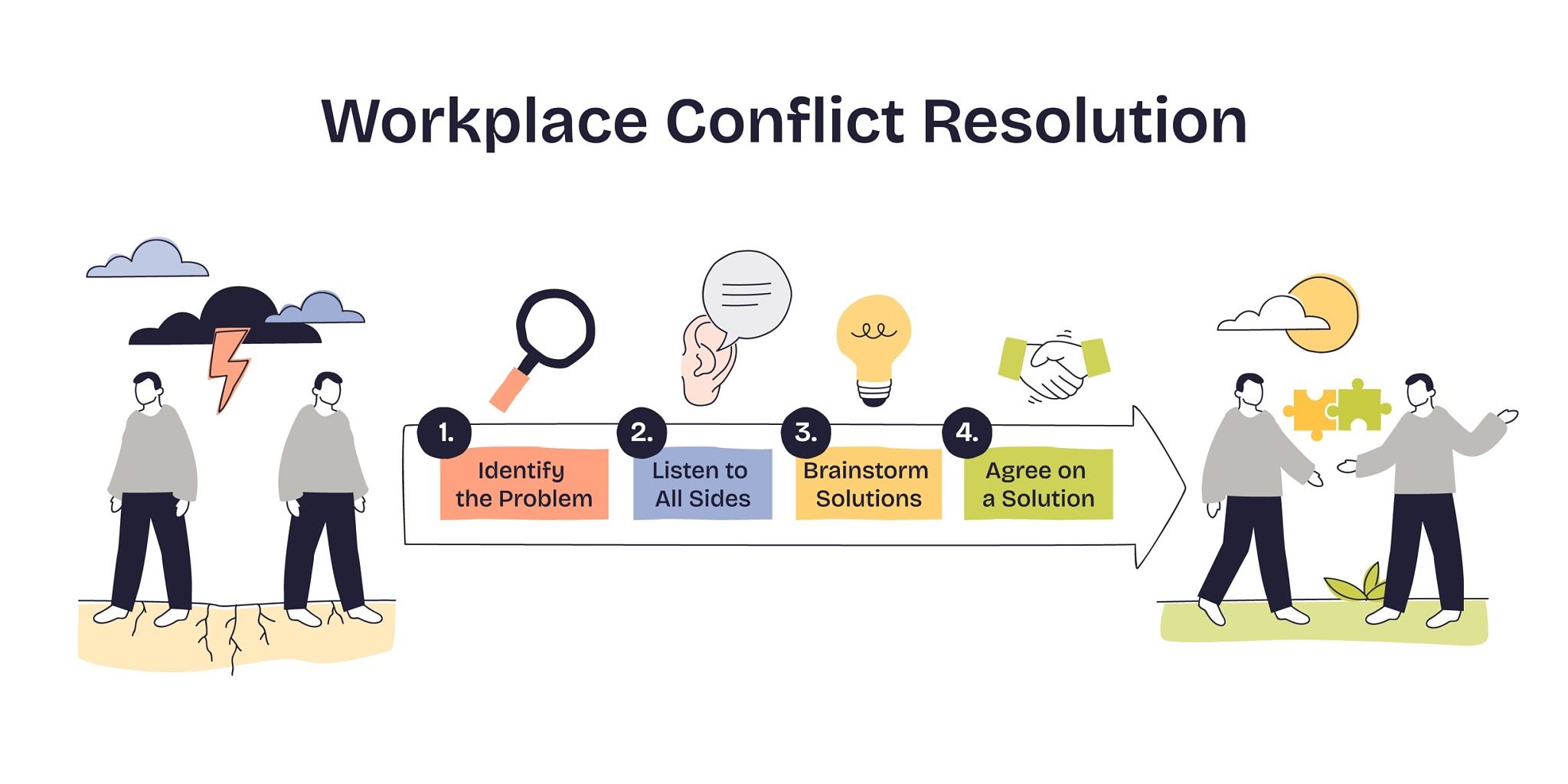
To operationalize these principles within managerial settings, leaders can utilize a structured four-stage process designed to de-escalate emotional volatility and focus on collaborative problem-solving (Rahim, 2011):
Identify the Root Issue
Distinguish surface-level symptoms from underlying structural or interpersonal drivers (Fisher, Ury and Patton, 2011). Separate objective facts from subjective interpretation.
Empathetic Discovery
Facilitate structured dialogue where all participants express their perspective without interruption, building active listening and mutual safety (Patterson et al., 2012).
Collaborative Synthesis
Shift focus from positional bargaining to integrative, solution-oriented brainstorming, identifying shared organizational goals (Fisher, Ury and Patton, 2011).
Covenant & Accountability
Formalize actionable commitments specifying deliverables, review timelines, and mutual accountability mechanisms (Lencioni, 2002).
4. Strategic and Organizational Outcomes
Cultivating psychological safety and formalizing conflict resolution protocols yields tangible organizational benefits (Edmondson, 1999). Companies that proactively manage dispute resolution experience lower turnover, higher employee engagement, and heightened creative synthesis across cross-functional teams.
Psychological Safety
Fosters an environment where team members feel safe taking risks and voicing concerns (Edmondson, 1999).
Interpersonal Clarity
Reduces communication ambiguities and eliminates structural inefficiencies across departments.
Enhanced Innovation
Leverages cognitive diversity to construct creative solutions through rigorous, healthy discussion (Rahim, 2011).
Sustainable Retention
Mitigates burnout and turnover associated with chronic organizational friction and unresolved hostility.
✨ Core Leadership Insight
"Peace is not the passive absence of conflict, but the courageous presence of justice, grace, and truth. Leaders must act as peacemakers—confronting challenges with clarity and empathy rather than avoiding them" (Sande, 2004; Lencioni, 2002).
Practical Applications for Organizational Leaders
- Pre-confrontation Reflection: Conduct self-examinations to clarify personal biases and strategic objectives before initiating dialogue (Patterson et al., 2012).
- Distinguish Person from Position: Focus critiques on actionable behavior and processes rather than personal character attributes (Fisher, Ury and Patton, 2011).
- Employ First-Person Communication: Frame perspectives using direct statements to lower defensiveness and encourage mutual openness.
- Establish Formal Mediation Channels: Utilize neutral third-party facilitators when emotional intensity blocks direct negotiation (Rahim, 2011).
- Embed Institutional Forgiveness: Develop policy frameworks that encourage learning from mistakes rather than punitive blame cycles (Edmondson, 1999).
Conclusion
Constructive conflict resolution is an essential capability for modern organizational sustainability. By harmonizing empirical leadership frameworks with foundational ethical values, institutions can transform potential friction into an asset that strengthens interpersonal relationships and drives organizational excellence.
References
- Covey, S.R. (2004) The 7 Habits of Highly Effective People: Powerful Lessons in Personal Change. New York: Free Press.
- De Dreu, C.K. and Weingart, L.R. (2003) 'Task versus relationship conflict, team performance, and team member satisfaction: a meta-analysis', Journal of Applied Psychology, 88(4), pp. 741–749.
- Edmondson, A. (1999) 'Psychological safety and learning behavior in work teams', Administrative Science Quarterly, 44(2), pp. 350–383.
- Fisher, R., Ury, W.L. and Patton, B. (2011) Getting to Yes: Negotiating Agreement Without Giving In. 3rd edn. New York: Penguin Books.
- Gottman, J.M. and DeClaire, J. (2001) The Relationship Cure: A 5 Step Guide to Strengthening Your Marriage, Family, and Friendships. New York: Harmony Books.
- Lencioni, P. (2002) The Five Dysfunctions of a Team: A Leadership Fable. San Francisco: Jossey-Bass.
- Patterson, K., Grenny, J., McMillan, R. and Switzler, A. (2012) Crucial Conversations: Tools for Talking When Stakes Are High. 2nd edn. New York: McGraw-Hill.
- Rahim, M.A. (2011) Managing Conflict in Organizations. 4th edn. New Brunswick: Transaction Publishers.
- Sande, K. (2004) The Peacemaker: A Biblical Guide to Resolving Personal Conflict. 3rd edn. Grand Rapids: Baker Books.
- Thomas, K.W. and Kilmann, R.H. (1974) Thomas-Kilmann Conflict Mode Instrument. Tuxedo, NY: Xicom.